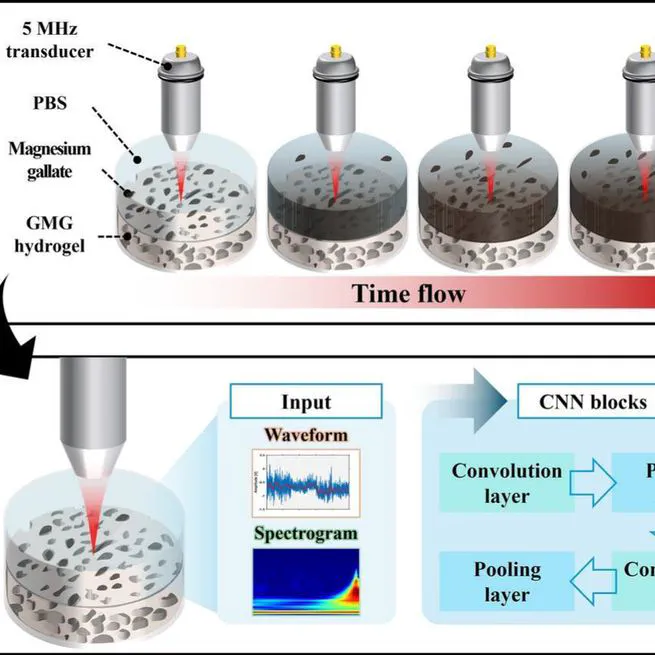
Non-invasive drug-release monitoring via AI-enhanced ultrasound in gelatin-magnesium gallate hydrogels
In summary, non-invasive monitoring of drug-release patterns fills a critical gap in drug-delivery research. Our study demonstrates the ability of deep learning frameworks to capture changes in ultrasound signals from hydrogels with varied concentrations of the crosslinker (magnesium gallate) and at different time points during the drug-release process, enabling automated profiling of drug release. First, we fabricated GMG hydrogels stabilized through magnesium gallate-mediated crosslinking and established ML models to differentiate the hydrogels based on crosslinker concentration under different dispersion medium (DMEM, 1x PBS, and water). For AI-based hydrogel concentration classification, the hybrid CNN-BiLSTM model performed best in the DMEM and 1x PBS conditions, with accuracies of 98.35% and 98.68%, respectively. In the water condition, the hybrid BiGRU model was more suitable, achieving an accuracy of 95.67%. Additionally, we successfully demonstrated gallic acid release patterns through ML analysis of processed ultrasound signals from hydrogels at various stages of drug release, indicating distinct degradation profiles. For time-based monitoring of hydrogel-mediated drug delivery, both the hybrid CNN-BiLSTM and BiGRU models achieved perfect classification accuracy (100%) across all experimental conditions (in vitro without HIFU, ex vivo, and in vitro with HIFU), highlighting their strong applicability for this task. However, the spectrogram-based multi-branch ViT-tiny model showed less favorable performance compared to the other architectures. This study does not extend to in vivo drug release profiling due to constraints such as respiratory motion artifacts and physiological barriers beyond the skin layer. Future studies should focus on developing dual-functional materials that harmonize robust thermal stability with enhanced acoustic responsiveness. Particularly, addressing signal attenuation caused by the thermal dissolution of the gelatin matrix is essential to extend the monitoring window in physiological environments. By integrating such thermally resilient scaffolds with motion-artifact-compensated algorithms, next-generation ultrasound-integrated hydrogel systems can realize their full potential for both precision drug release and long-term clinical monitoring.
May 7, 2026