Aqua-Sense: Relay-Based Underwater Optical Wireless Communication for IoUT Monitoring
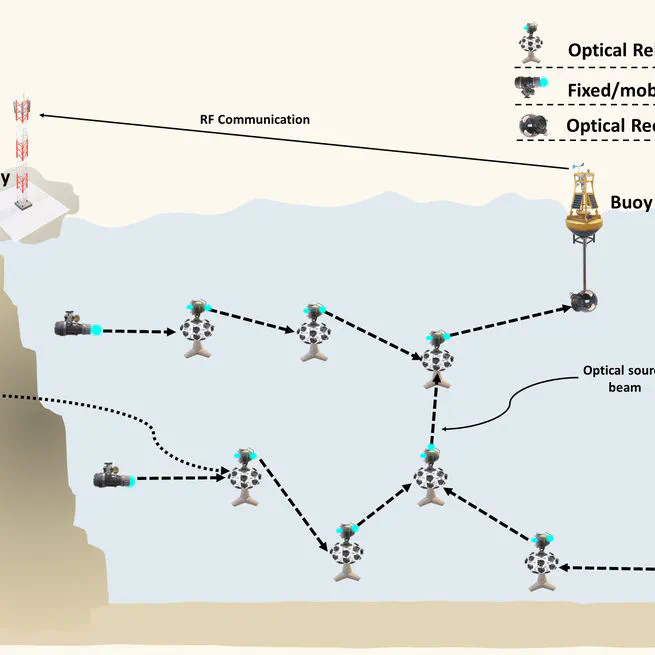
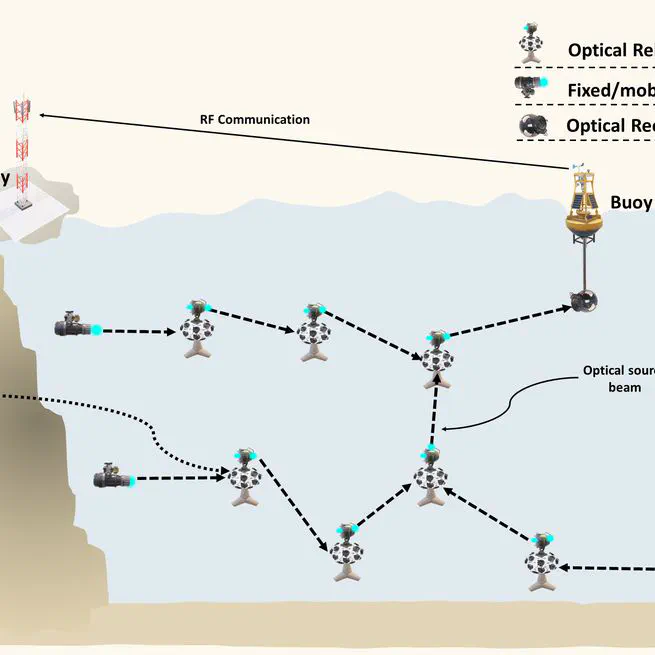
Water turbulence, range, and misalignment reduce underwater wireless optical communication (UWOC) performance. These obstacles may hinder large-scale deployment. Compared to acoustic and RF communication, UWOC can connect IoUT devices. “Aqua-sense,” a relay-based UWOC system, was designed and tested to improve communication connection performance and optical receiver reception area. EGC, MLC, and SC are used in the optical relay to increase diversity gain. A channel-aware algorithm powers the optical relay, or “opto-relay,” to increase communication connection performance. At 0.2 Mbps and 7.5 meters, the aqua-sense system had a 68% packet success rate in fairly murky water at 25 NTU. The sensor node, “opto-sense,” transmitted 0.5 Mbps in clear water with 0.01 NTU turbidity. Moderate water waves and air bubbles with a displacement and airflow rate of 5 liters/min within a 2-meter communication link range did not affect our results.
Feb 19, 2024
Multiuser Data Transmission Aided by Simultaneous Transmit and Reflect Reconfigurable Intelligent Surface in Underwater Wireless Optical Communications
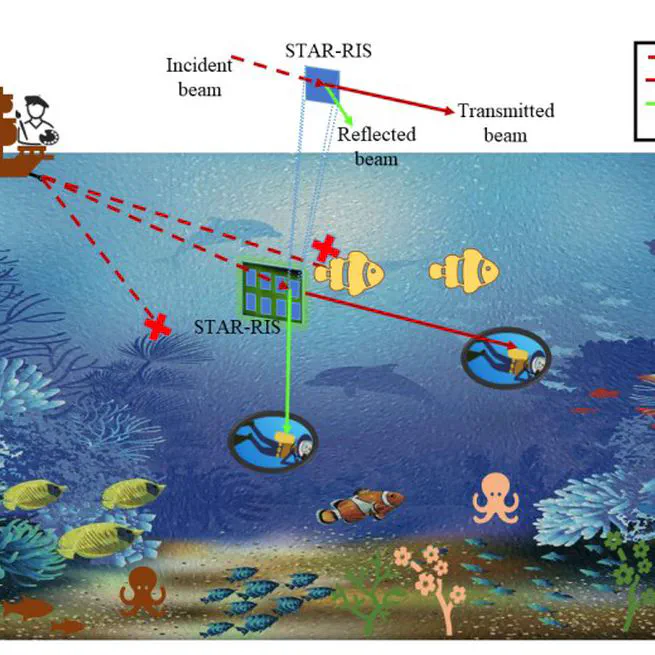
The reconfigurable intelligent surface (RIS) can improve energy and spectrum efficiency by directing radio waves. Recent wireless communications research has focused on it. We utilized the simultaneous transmit and reflect (STAR)-RIS to an underwater UWOC system in this work. Despite underwater turbulence, beam attenuation, blockage, and pointing mistakes, a STAR-RIS obtains a UWOC channel to allow multiple users to transfer data in all directions. Exponential and generalized Gamma distributions were used to calculate underwater turbulence-induced fading, and numerical analysis was used to evaluate the outage probability, bit error rate (BER), and channel capacity of direct, conventional, and STAR-RIS assisted UWOC channels. BER performance was also assessed based on reflective element count, modulation method, pointing errors, blockage levels, and transmit-reflection coefficient. Monte-Carlo simulations verified the analytical BER and outage probability conclusions for the average signal-to-noise ratio. Experiments showed the receiving luminous intensity performance compared to the incident beam luminous intensity of the proposed STAR-RIS aided UWOC channel.
Jan 24, 2024
Multiuser data transmission aided by simultaneous transmit and reflect reconfigurable intelligent surface in underwater wireless optical communications
Add the full text or supplementary notes for the publication here using Markdown formatting.
Jan 1, 2024
Machine Learning-Assisted Object Monitoring Supported by UWOC for IoUT
Add the full text or supplementary notes for the publication here using Markdown formatting.
Jan 1, 2024
Image-based VLC Signal Demodulation Using Machine Learning
Add the full text or supplementary notes for the publication here using Markdown formatting.
Jan 1, 2024
Design and performance evaluation of a relay-assisted hybrid LoRa/optical wireless communication system for IoUT
Add the full text or supplementary notes for the publication here using Markdown formatting.
Jan 1, 2024
Aqua-sense: Relay-based underwater optical wireless communication for IoUT monitoring
Add the full text or supplementary notes for the publication here using Markdown formatting.
Jan 1, 2024
Underwater Optical Image Data Transmission in the Presence of Turbulence and Attenuation
Add the full text or supplementary notes for the publication here using Markdown formatting.
Jan 1, 2023
Experimental and simulation study of a LoRaWAN-assisted relay for IoUT communication
Add the full text or supplementary notes for the publication here using Markdown formatting.
Jan 1, 2023
A Multi-hop Resource Efficient UWOC-Link assisted Local Area Network for UIoT Monitoring
Add the full text or supplementary notes for the publication here using Markdown formatting.
Jan 1, 2023