Non-invasive drug-release monitoring via AI-enhanced ultrasound in gelatin-magnesium gallate hydrogels

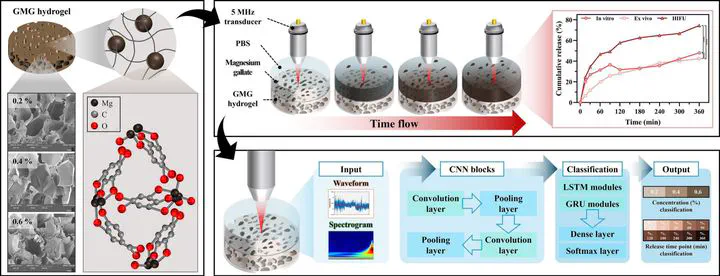 Image credit:
Abstract
Hydrogel-based drug delivery systems have been actively explored for precision and personalized medicine, leveraging their localized, sustained, and biocompatible approach for drug administration. However, conventional platforms generally lack real-time monitoring capabilities, as therapeutic evaluation typically relies on invasive or end-point analyses. While stimuli-responsive hydrogels offer controlled release, non-invasive strategies to track in vivo release kinetics is still challenging. We addressed these limitations using an acoustic system coupled with a deep learning framework to analyze ultrasound (US) signal variations from a gelatin-magnesium gallate (GMG) hydrogel, thereby demonstrating the feasibility of non-invasive, time-dependent drug release monitoring. A machine-learning framework quantitatively decodes subtle acoustic variations, enabling non-invasive monitoring with > 95% accuracy. GMG hydrogel was fabricated using highly porous magnesium gallate MOFs (metal–organic frameworks), and the drug (gallic acid) release-mediated structural changes in the hydrogel were observed through US signal variations. Drug release was validated under diverse experimental conditions to ensure reproducibility of the results. Integration of US with AI-based analysis demonstrates the potential for non-invasive, real-time monitoring of drug release from hydrogel-based systems by analyzing the complex pattern of US signals and maintaining hydrogel integrity that enables insight into structural changes during drug release.
Type
Publication
- Material & Design, 116138