Decoding chemical composition of urinary crystals from ultrasonic echo signals via deep learning

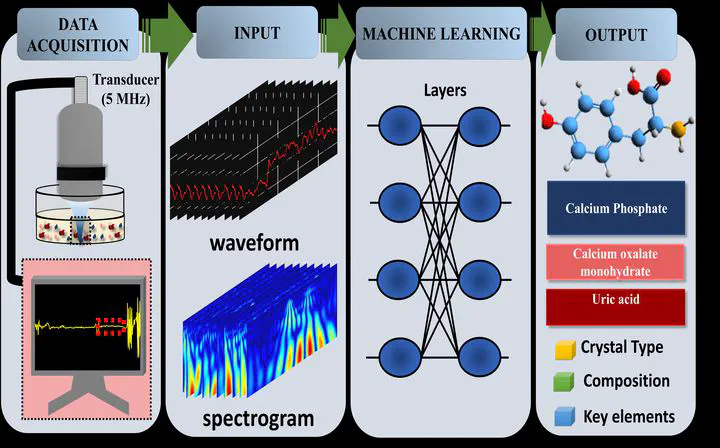 Image credit:
Abstract
Conventional analyses of urinary stones like estimation of urinary markers provide ambiguous predictions on the type of stone while XRD, and FT-IR can only be performed on surgically removed samples. Hence, current clinical practice lacks non-invasive methods for early and accurate classification of stones based on their composition. This study presents an ultrasound-based non-invasive system integrated with a machine-learning algorithm for analyzing acoustic signals to classify in vitro fabricated urinary crystals. Calcium oxalate, calcium phosphate, and uric acid crystals were synthesized, characterized, and embedded in gelatin-based gel phantoms. Following morphological characterization of the crystal-infused phantoms, ultrasonic echo signals were acquired and processed using machine learning-based analytical models. The results demonstrated that the ultrasound-based system effectively enables non-invasive analysis of urinary stones and can provide information on their location and structural characteristics. In parallel, the machine-learning component enhances diagnostic accuracy by classifying the stone composition from the analyzed acoustic signals, facilitating early and precise diagnosis. This approach highlights the potential of ultrasound and AI integration as a reliable diagnostic tool for personalized stone-management strategies.
Type
Publication
- Microchim Acta , 193*(286)